Student Leadership as a Catalyst for Health Equity and Economic Opportunity
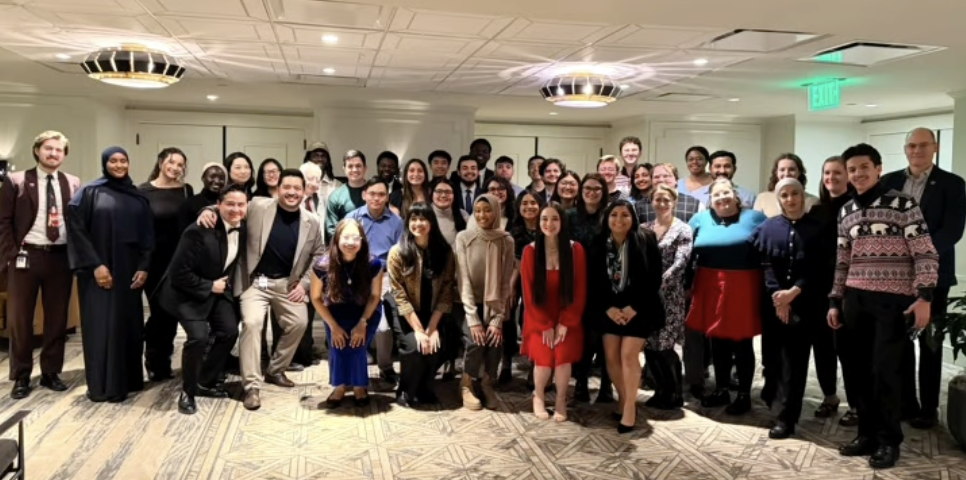
2025 UNMC SEAC Holiday Party
Spaces where student leadership, institutional responsibility, and community engagement intersect are essential to building equitable systems. These spaces are where ideas evolve into commitments and where future professionals begin shaping the structures they will one day lead.
The Latino Economic Development Council (LEDC) exists to advance economic opportunity, health equity, and civic power for Latino and immigrant communities through systemic change. This mission is rooted in a clear understanding: economic and health systems in the United States were not designed to work for everyone, yet individuals are often expected to overcome structural barriers through effort alone. That approach is neither fair nor effective.
Redefining Economic Development
Economic development is frequently discussed in terms of growth, investment, or GDP. At LEDC, economic development is measured by whether growth translates into opportunity for the people who live and work in the community.
This work includes supporting entrepreneurs as they start and scale businesses, connecting workers to quality jobs with real career pathways, and helping families build credit, assets, and long-term financial stability. When economic growth fails to improve lived experiences, growth alone is not enough.
Health Equity as an Economic Strategy
Health and economic opportunity are deeply interconnected. When individuals cannot access care in their language, when preventive services are out of reach, or when immigration status, transportation barriers, or fear prevent people from seeking care, education and employment outcomes suffer. Economic stability becomes increasingly difficult to sustain.
For this reason, LEDC treats health equity as an economic strategy—not a secondary issue. Health determines whether people can show up to work, remain in school, care for their families, and participate fully in civic life.
The Role of Future Medical Professionals
Medical education carries extraordinary responsibility and trust. Health care is practiced within systems that either remove barriers or reinforce them, and every clinical encounter is shaped by factors beyond the exam room. Language access, housing stability, immigration status, employment conditions, and patient safety all influence health outcomes.
Medical professionals do more than diagnose and treat illness. They influence who is heard, who is believed, and who experiences dignity during moments of vulnerability. When these realities are understood early in training, health care becomes not only a means of treatment, but a pathway to equity, stability, and economic mobility.
Student engagement in health equity spaces is therefore critical—not later in professional careers, but now, while perspectives and professional identities are still forming.
Civic Leadership Beyond Titles
Meaningful change does not occur only in boardrooms or legislative chambers. It happens when individuals understand how systems function, how decisions are made, and how those decisions can be influenced.
LEDC invests in civic leadership, particularly among young people, to ensure leadership pipelines are not limited to those already close to power. Programs such as Youth Activators are designed to expand access to leadership opportunities and build long-term civic capacity. Opportunity should not depend on proximity to influence.
This commitment is reflected in LEDC’s work in South Omaha, where preserving culture goes hand in hand with building infrastructure, opportunity, and shared prosperity. One example is the revitalization of Plaza de la Raza—transforming a historically significant space currently used as a parking lot into a community park that honors roots while creating space for connection and celebration.
Communities should not be displaced by development. They should benefit from it.
Why Student Engagement Matters
Student engagement is not extracurricular; it is civic leadership. Students are not only the future of institutions like UNMC—they are part of their present accountability. Student voices help shape policies, priorities, and institutional cultures that determine how equitable and responsive systems truly are.
Supporting student-led health equity initiatives reflects a belief that student perspectives should inform decision-making, that health equity requires cross-sector collaboration, and that universities must serve as active partners in community transformation.
Institutions that educate future healthcare professionals play a critical role in shaping regional health outcomes. Who is welcomed into classrooms, who feels seen within systems, and who is empowered to challenge inequity will influence community health for decades to come.
Building Equity Through Action
Equity is not an abstract value. It is built through intentional action, collaboration, and leadership at every level. When students, institutions, and community organizations work together, lasting change becomes possible—not someday, but now.
